
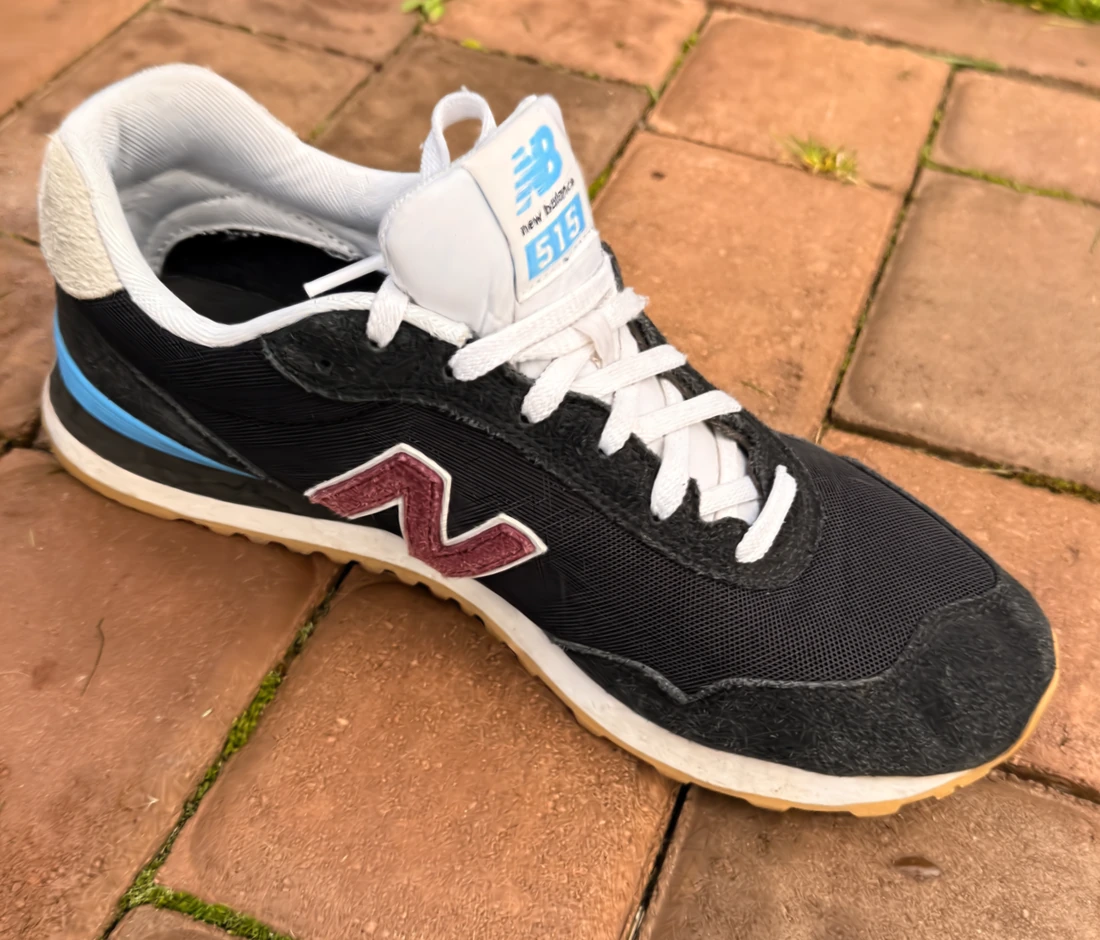
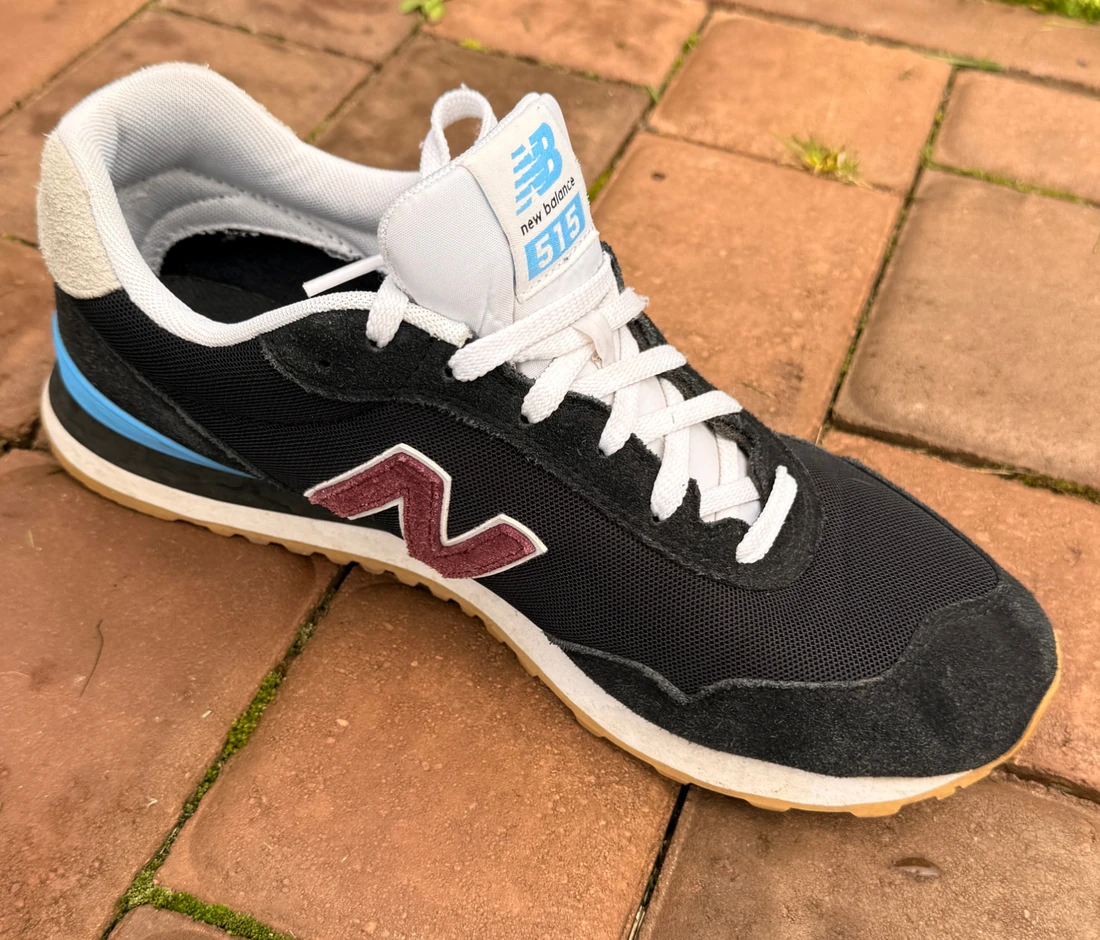
We put a sneaker on a garden path and walked around it with an iPhone. The shoe stayed still. The camera moved. Those photographs became the starting point for our first Gaussian Splat.
The goal of EXP000 was deliberately narrow: complete the chain from a physical product to an interactive browser result using existing tools. Before designing a better capture system, we needed a baseline we could inspect and improve.
A different way to represent what we see.
A conventional textured mesh describes a surface using triangles and images. Gaussian Splatting represents a scene using many small, overlapping 3D elements with properties such as position, size, opacity, and appearance. Training adjusts them so that rendered views resemble the source photographs.
This makes it interesting for product visualization. It also raises a question: how much of a product’s recognizable appearance survives when we move beyond a single photograph?
Can our own phone photographs become a coherent Gaussian Splat that supports new views, export, and browser interaction?
We used Nerfstudio’s Splatfacto implementation of Gaussian Splatting. The underlying method comes from published research; our experiment tests its practical use for a real product.
Keep the product still.
Move the camera.
The subject was a New Balance sneaker. We used an iPhone 16 Pro Max, the main 1× camera, and RGB photographs. LiDAR was not used.
The static dataset contained 125 photographs at 3213 × 5712 pixels. We prepared sRGB working copies at 1406 × 2500, preserving the originals. The camera moved around the shoe at different heights; there was no turntable.
We intentionally left the underside uncaptured. The purpose of this first test was to establish a working process, before tackling object repositioning and full coverage. The garden path and surrounding background remained part of the scene.
Establish where each photo was taken.
Before training, we used COLMAP to estimate camera positions and build a sparse point cloud. This stage still relies on Structure from Motion, a technique also used in photogrammetry. The change here is in the final scene representation and optimization, rather than the removal of camera reconstruction.
All 125 images registered in one connected reconstruction. We inspected the camera trajectory, orientations, and sparse points before proceeding. The shoe was recognizable in the point cloud, and tracked features appeared on the shoe as well as the ground.
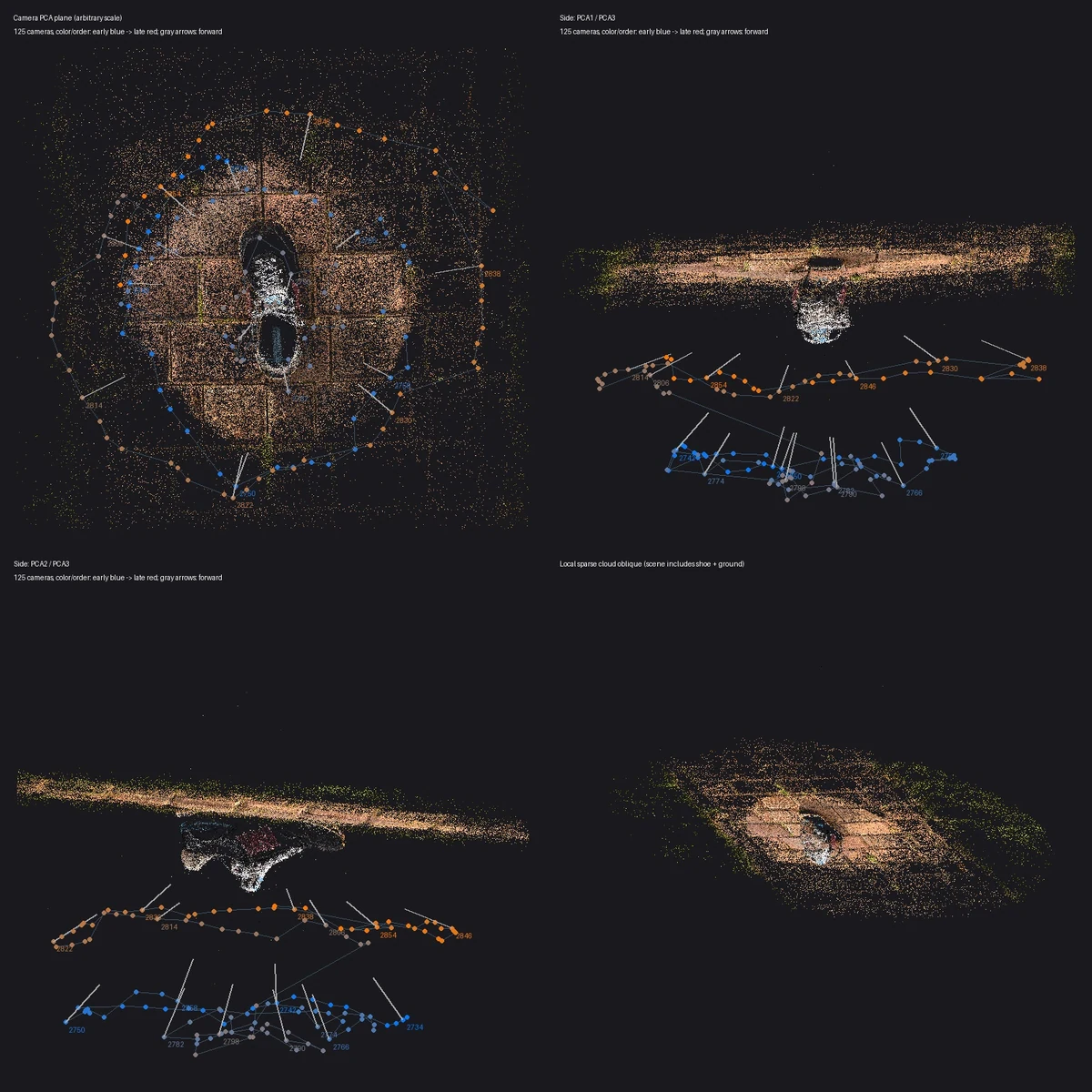
The three COLMAP stages took about 5 minutes 20 seconds on the Mac’s CPU, excluding installation and preprocessing. Camera registration passed our baseline quality gate; it did not establish the final visual quality of the product.
From sparse points to a viewable scene.
With the camera reconstruction accepted, we trained Splatfacto on a cloud NVIDIA RTX 4090. The baseline ran for 30,000 iterations in 34 minutes 58 seconds.
The exported model contained 1,053,082 Gaussians after the exporter removed low-opacity elements. The resulting master PLY was approximately 249 MiB. That master was preserved separately from the smaller browser delivery.
Training used 110 images. The other 15 were held out from the GS training loss for visual comparison and image metrics. All 125 images participated in the earlier camera reconstruction and sparse initialization.
The first result held together.
The details told a fuller story.
We reviewed all 15 paired evaluation views and key frames from an interpolated camera path. The overall shoe shape remained coherent in the inspected views. Laces, the tongue, side logos, and the visible sole made the object recognizable as we changed viewpoint.
Closer inspection showed softer fine detail, including small text and material texture. The background was less convincing from new angles. That is why the paired photographs matter: they make the difference between a plausible image and a faithful reconstruction visible.
Reported evaluation metrics over full images, including the background. Higher PSNR and SSIM and lower LPIPS indicate closer image similarity; they do not independently measure geometric or product accuracy.
What this experiment does not prove.
This was one object, one capture session, and a scene-inclusive reconstruction. It supports the feasibility of this particular phone-to-GS process. It does not establish superiority over a mesh workflow, general performance across products, or production readiness.
- The object is not isolated. Ground and foliage were reconstructed alongside the sneaker. A reusable product asset needs a deliberate object boundary.
- Coverage is incomplete. The underside was intentionally excluded. A convincing upper view cannot validate an unseen surface.
- The evaluation is not fully independent. The 15 comparison photos contributed to camera estimation and sparse initialization. There was no separate, fully independent end-to-end test set.
- Appearance is not metric geometry. Physical scale, surface accuracy, relighting, and AR suitability were not established. Browser FPS, time to first frame, and mobile performance were not benchmarked.
Give the reconstruction
a place in the browser.
We converted the exported splat with PlayCanvas SplatTransform into a self-contained browser package of 25.2 MiB. Local loading, orientation, and orbit interaction were checked. This was an existing viewer baseline, with no custom Gaussian renderer.
A photograph gives you a view.
A reconstruction lets you move.
Load the original EXP000 browser viewer. The scene includes the garden background.
25.2 MiB · Graphics support required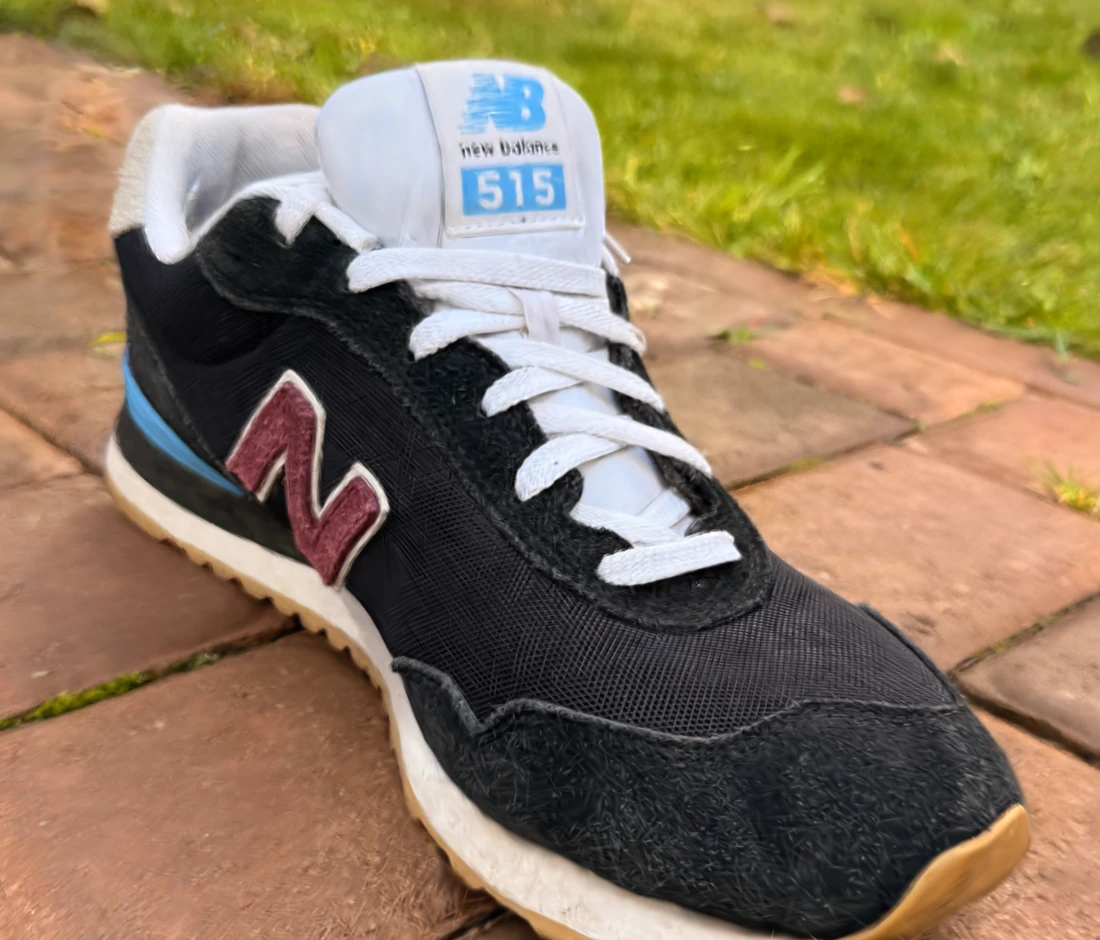
Viewer controls: drag to orbit and scroll to zoom. Press Escape if the saved viewer starts animating; use the orange orbit control to return to object orbit. Open the viewer in its own tab ↗
The compressed delivery made the experiment easier to inspect and share. It did not remove the need for product isolation or establish acceptable loading speed on customer devices.
A working beginning.
A clearer next question.
EXP000 completed the chain we set out to test: real shoe → photographs → accepted camera poses → trained Gaussian Splat → novel views → export → browser.
The next research question was how to separate the sneaker from its surroundings and capture more of the object, including the sole, while keeping its details consistent. Later experiments address those questions; they do not change the scope of this first baseline.
For product digitization, the useful result is a process we can evaluate. We now have real artifacts, visible failure modes, and a reference against which to judge the next approach.
Our static iPhone capture produced a coherent, viewable Gaussian Splat. A complete, isolated, delivery-ready product remains a further research task.
Technical details & reproducibility
Recorded EXP000 configuration—not a recommendation to use these historical versions for a new project.
- Capture
- iPhone 16 Pro Max · RGB · main 1× camera · static sneaker · no LiDAR
- Dataset
- 125 source JPEGs, 3213 × 5712; sRGB working copies, 1406 × 2500; 110 GS training / 15 evaluation
- Camera reconstruction
- COLMAP 4.2.1, CPU · one shared SIMPLE_RADIAL camera · all 125 registered · 111,892 sparse points · mean reprojection error 0.926 px
- Training stack
- Nerfstudio 1.1.5 / Splatfacto · gsplat 1.4.0 · PyTorch 2.4.1+cu124 · seed 0
- Compute
- NVIDIA RTX 4090 · 30,000 iterations · 2,098.45 seconds training time
- Memory observation
- 6,273 MiB sampled GPU-memory high-water mark; sampled every 5 seconds, not a guaranteed instantaneous peak
- Representation
- 1,059,968 trained Gaussians; 1,053,082 exported after low-opacity removal
- Assets
- Master PLY: 261,165,930 bytes; browser HTML: 26,425,967 bytes (25.2 MiB)
- Delivery
- PlayCanvas SplatTransform 3.10.0 · three spherical-harmonic bands retained · master preserved separately
- Evaluation boundary
- Full-frame metrics include background. Evaluation views enter SfM and sparse initialization. No independent test set or object-only metric claim.
- Provenance
- Originals, configs, split lists, logs, dependency snapshots, and SHA-256 manifests retained locally. No Git commit was available for the original run.
Methods & acknowledgments
We build on the work of the researchers and maintainers behind these tools:
- Kerbl et al. — 3D Gaussian Splatting for Real-Time Radiance Field Rendering (2023) ↗
- Nerfstudio — Splatfacto ↗
- COLMAP — Structure from Motion ↗
- gsplat — Gaussian rasterization ↗
- PlayCanvas — SplatTransform ↗
Experiment completed 7 October 2026; completion report closed 8 October 2026. Editorial draft prepared 18 November 2026. Photographs and renders are actual EXP000 artifacts; web derivatives use cropping, resizing, and compression without generative retouching. New Balance is the maker of the test object; this experiment does not imply affiliation or endorsement.